Western Winds

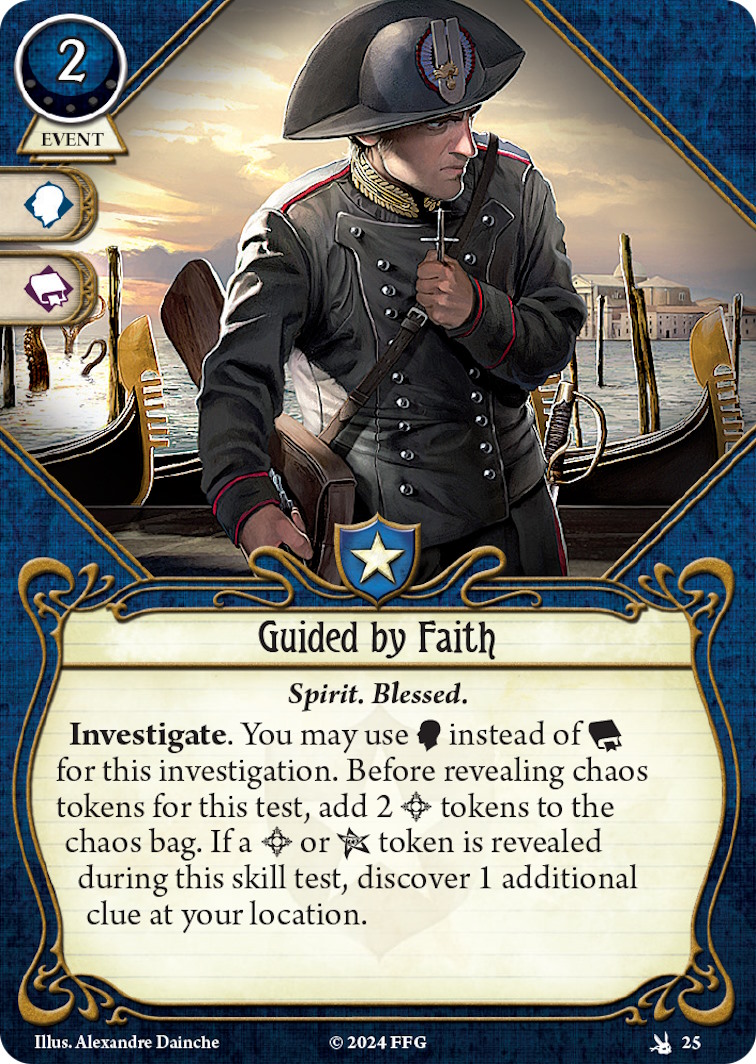
Очередной косяк баланса от разработчиков в этой кампании: условием срабатывания ветров является вытаскивание любого жетона с символом, кроме Знака древних. Если у вас в группе есть сестра Мэри, Кохаку или любой другой следователь набивающий мешок доверху жетонами благосов/проклятий эта карта будет активироваться кратно чаще и играться сценарий будет совершенно по другому.

Rentgen · 1
André Patel

tl;dr André Patel doesn't reinvent the class for Chapter 2, he simply excels in many aspects of what the class has always wanted to do.


With the Chapter 2 refresh pushing the original card pool into legacy territory, it feels fitting that one of the first new investigators out of the gate is a that so completely understands what his class actually is all about. André Patel is not trying to reinvent the class. He is instead an almost suspiciously efficient distillation of everything the class has historically wanted to do and he does it well.

At first glance, his statline tells you nearly everything you need to know. 5 immediately places André among the elite evade-focused investigators in the game, meaning he can effortlessly handle enemy management in classic fashion: by embarrassing enemies and leaving them in the dust. The new card pool has also maintained Rogues' past shenanigans of exploiting their stat by adding your value to other tests or by using your as a base skill on its own for other actions.

But where that 5 shines is in André's ability:

  • After you succeed at a skill test by 2 or more during your turn: You may take an additional action this turn. (Limit once per round.)”

This is quintessential : oversuccess has always been one of the class’s defining mechanical identities, and André turns it directly into the most valuable resource in the game: actions. Importantly, this ability doesn’t ask you to jump through bizarre hoops or build around obscure interactions. Rogues already want to oversucceed. Rogues already stack agility boosts. Rogues already leverage burst turns and tempo advantages. André simply rewards you for playing Rogue the ways Rogue wants to be played

And because this is simply “during your turn” rather than tied to a specific action type, the flexibility here is enormous. Evade by 2? Gain an action. Investigate a low-shroud location by 2? Gain an action. Land a flashy combat trick by 2? Gain an action. It creates that classic Rogue snowball effect where one successful test starts cascading into a wildly productive turn.

His effect reinforces his quintessentially roguish identity beautifully in another way:

  • effect: +2. Gain 1 resource.

The +2 helps guarantee the kind of oversuccess André wants anyway, while the extra resource quietly nudges him toward the big money archetype which also seems to be a direction the designers are really pushing the Rogue class. Between Rogue cards that generate resources and incidental resource generation from his effect, André looks extremely comfortable in builds that convert wealth into tempo, stat boosts, or testless value (as evidenced in this deck by HungryColquhoun.) It is another elegant example of every part of his design pulling in the same direction of simply Rogue: exploiting success into more actions and resources to snowball into more successes.

And then there are his signatures. Rather than giving him one flashy signature asset, André instead gets three signature skills. Each begins with a single icon to commit, but gains when committed to a specific type of test. They seem underwhelming at first glance, but mechanically, these are perfect for André. Rogues love explosive skill values because the class’s entire ecosystem rewards oversucceeding. These signatures all but guarantee that Andre can trigger his ability consistently. These cards are not asking the player to solve a puzzle or assemble a combo engine. They simply amplify the thing André already loves doing: turning favorable odds into overwhelming success.

What I appreciate most about André is how cohesive he feels. Some Rogue investigators historically leaned heavily into one aspect of the class fantasy while sacrificing others. You had the evade specialists, the big money folks, the overachievers, the action cheaters: André feels like a deliberate attempt to unify all of these Roguish threads into a single investigator.

He evades well. He oversucceeds naturally. He converts tempo into explosive turns. He supports big money.

Ultimately, what makes André so appealing is that he is, in many ways, a "Rogue's Rogue."

My only concern is that he may simply be too generically powerful in what is supposed to be a reset for the game. Action generation tied to something Rogues already excel at is inherently dangerous design space, especially on a chassis this efficient. A once-per-round limiter helps considerably, but it is not difficult to imagine Andre turns routinely functioning at a tempo advantage over much of the roster. His signature skills further increase the consistency of triggering that engine.

Whether that proves merely strong or genuinely oppressive will likely depend on the broader Chapter 2 card pool and if they decide to progress the class into new territory as they appear to be doing with the class and damage.

If Chapter 2 is trying to refine class identities into their clearest and most mechanically satisfying forms, then André may be the clearest expression yet of what Rogue is supposed to feel like: stylish, slippery, opportunistic, wealthy, and constantly one step ahead of the game.

grifjo06 · 4
Longbow

One point I've seen people make in favor of Longbow is that it's "good against Aloof enemies." Not true for most of them. In most cases, when you want to deal with an Aloof enemy, you spend one action to engage it, and one action to bop it with whatever random weapon you have (or even your bare hands, for birds or many random cultist-types). With the Longbow, you spend one action shooting the enemy and one action reloading. Still two actions spent. For most aloof enemies, the "ignores the aloof keyword" text isn't making this good against Aloof enemies, it's making it not a total disaster. Where Longbow is actually good is when it's an Aloof enemy with exactly 3 hp, AND your alternative weapon deals 2 damage - now you're talking about 2 actions for Longbow vs 3 actions otherwise. There are a couple campaigns with a decent number of 3 HP Aloof enemies, but generally Aloof enemies have only 1 or 2 HP, so Longbow isn't actually gaining you any significant value relative to other ways you could be dealing with that enemy.

CitizenFry01 · 53
Yeah, totally agree. Now on an aloof boss with massiv health, tht is expected to not go down in a round and possibly be evaded, this might also be worth it. Because you can just chip on it without engagement, while somebody, who evades would need to reengage them next round. But that's a very unlikely edge case, and chances are somebody would need to engage them in bigger groups anyway, because you won't deal with them on your own. — Susumu · 390
Custom Grip

Easily one of the best card of Tommy's pack: Custom Grip fixes so many issue with firearms (mainly the risk of running out of ammo at the wrong moment) and actually makes guns worth building around at least and gives a serious blow against melee's supremacy in Guardians deck (alongside the Machete nerf)

For one resource, you get INSANE value: a play action of a weapon, the ability to return the weapon to your hand and play it again or another one. So essentially you get to refresh a gun or replace it while keeping in hand the original gun you played. That is incredibly good tech at level 0 and it scales so, so well when you start using higher level guns, like the Lightning Gun.

This is a staple in all of my firearms deck that can access it: it singlehandely removes any risk of running out of ammo in inopportune moments.

Tempt Fate

Tempt Fate is a weird event that really didn't quite find a home in any deck beside few odd ones using Paradoxical Covenant... Until Kōhaku Narukami joined the team, where this card is basically an auto-include in his deck. Why? Because of his ability to burn 2 curse and bless token to get an extra action. Basically this card on him reads:

"Fast. Play when your turn begins.

As an additional cost to play this card add 1 Bless token and 1 Curse token to the chaos bag.

Draw a card and take an additional action this turn."

It's incredibly good and effective at level 0 and gives a lot of flexibiliy to Kōhaku on how to act. The draw is basically a net gain of 2 actions, which is almost unheard at level 0 decks normally.

I love when niche cards find such an effective home in certain decks, like Opportunist on Winifred Habbamock!